Table of Contents
Introduction
The first time I made stuffed bell peppers, I was feeling confident… right up until I pulled the pan out and saw a puddle of tomato-y liquid under every pepper. The filling tasted fine, but the peppers were kind of steamed, the rice went soft, and the cheese slid off like a hat in the rain. Since then, I’ve made them enough times to learn what actually matters: how you manage moisture, how snug your baking dish is, and when to cover (and when to stop covering). This is the version I make now—tender peppers, filling that holds together, and leftovers that reheat
Why This Recipe Works
- For you if you want a com
- Great when you have leftover rice or a pound of ground meat to use up
- Solves the “watery pepper” problem with simple moisture control
- Uses everyday ingredients, but still tastes like you tried
- Easy to scale: 4 peppers for small nights, 6–8 peppers for meal prep
Ingredients (With Real Context)
Bell peppers (4–6 large)
I like red/yellow/orange for sweetness, but green works if you want more bite. A
Ground beef (about 1 lb, ideally lean)
Leaner beef avoids a greasy filling. If you use higher-fat beef, drain it well o
Cooked rice (about 1 ½–2 cups)
Leftover rice is honestly a superpower here. Freshly cooked rice can be a little steamy/wet and can push you toward mushy filling. If your rice is fresh, spread it on a plate for 10 minutes to let steam escape.
Tomato base (tomato sauce + a little tomato paste)
Sauce gives moisture and tang; paste adds body so the filling doesn’t slump. This is one of my main “watery batch” fixes.
Aromatics: onion + garlic
Cook them un
Cheese (optional, but I usually do it)
Mozzarella melts nicely; cheddar tastes sharper; Monterey Jack is a happy middle. If y
Seasoning
Italian seasoning works, but I prefer a mix: oregano + basil + black pepper. Worcestershire sauce is optional, but it adds a savory edge.
Dietary substitution bullets
- Gluten-free: naturally gluten-free if your Worcestershire is GF
- Vegan: use lentils or plant-based crumble +
- Low-sugar: use no-sugar-added tomato sauce; lean harder on herbs and garlic
Timing
Prep Time (ISO 8601: PT25M)
Co
Total Time (ISO 8601: PT1H10M)
Realistic comparison: about the length of a load of laundry + a little cleanup.
Step-by-Step Instructions (Decision-Based)
- Heat the oven to 375°F and choose the right baking dish.
What to do: Pick a dish where peppers fit snugly. Ad
Why it matters: Snug peppers stand up and bake more evenly; sauce below prevents scorching.
What to look for: Peppers should touch or nearly touch. - Prep the peppers (and decide: pre-soften or not).
What to do: Cut tops off, remove seeds/membranes. If your peppers are thick-walled, microwave them with a splash of water for 3–5 minutes.
Why it matters: Pre-softening helps peppers get tender without overbaking the filling.
What to look for: Peppers - Brown the beef properly.
What to do: Cook beef until you see real browning (not gray crumbles), then season. Drain excess fat if needed.
Why it matters: Browning creates deeper flavor; seasoning too early can pull out moisture.
What to look fo - Build the filling so it holds together.
What to do: Add onion/garlic, cook until fragrant. Stir in tomato sauce + a spoon of tomato paste. Simmer 5–10 minutes. Add cooked rice last.
Why it matters: Simmering reduces watery sauce; rice a
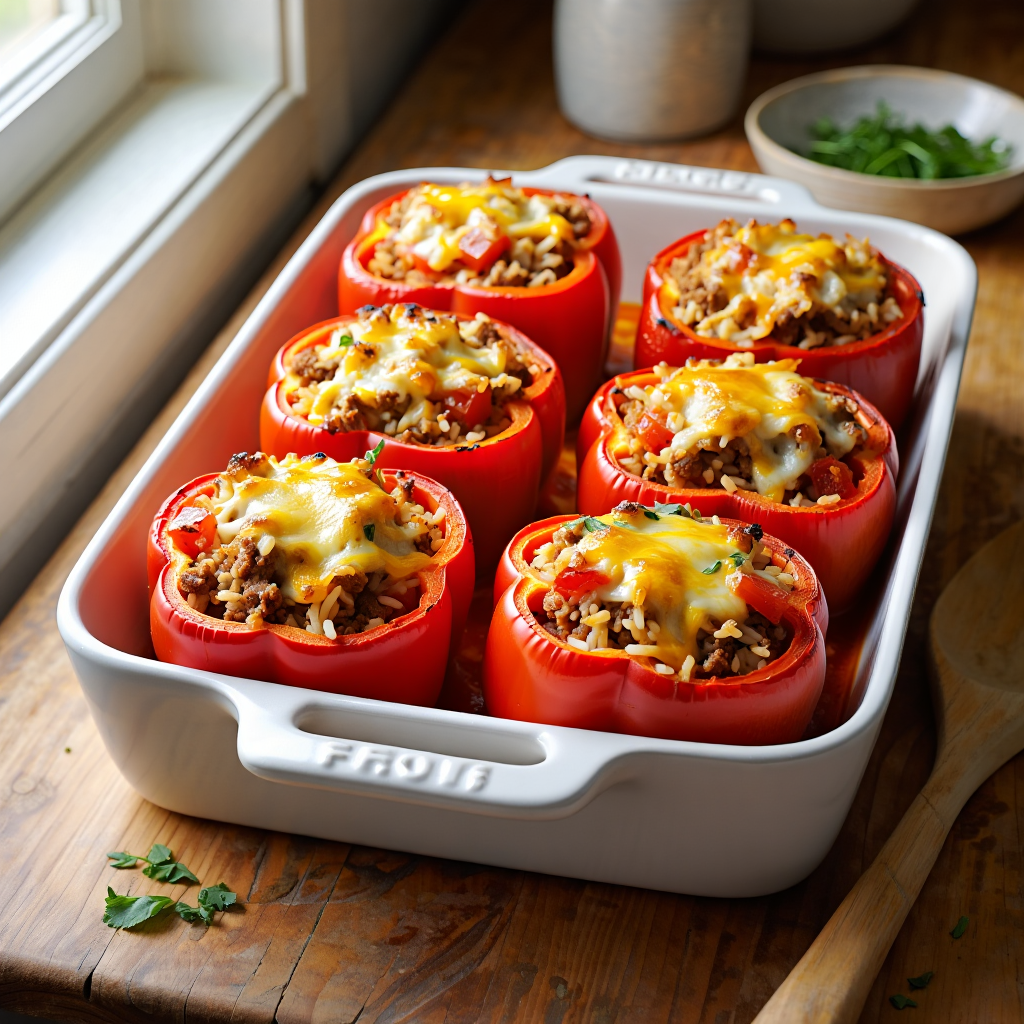
What to look for: Filling should look spoonable, not soupy. It should mound on a spoon. - Stuff without packing like concrete.
What to do: Fill peppers, pressing gently but not smashing. Spoon a little sauce over tops if you like.
Why it matters: Overpacking can make the center dense and slow to heat.
What to look for: Filling sits slightly above the rim but doesn’t crumble. - Bake covered, then uncovered.
What to do: Cover with foil for 25 minutes, then uncover 10–15 minutes. Add cheese for the last 10 minutes if using.
Why it matters: Covered baking softens peppers; uncovered time evaporates surface moisture.
What to look for: Pepper skin is wrinkly and fork-tender; sauce is bubbling at edges. - Rest before serving.
What to do: Let sit 5–10 minutes.
Why it matters: Filling firms up; you get clean bites instead of a collapse.
What to look for: When you cut into one, rice and meat stay together.
Pro Tip: If you want a punchier version, stir a small spoon of harissa into the filling and call it dinner. (You’ve got a great harissa explainer on the site too.)bestwayrecipes.com
Common Mistakes I Made & How I Fixed Them
- I ended up with watery peppers and a puddle in the pan.
What went wrong: I used too much thin tomato sauce and didn’t simmer the filling.
Why it happened: The peppers release water as they bake, and thin sauce can’t “hold” it.
Fix: Simmer the sauce 5–10 minutes and add a little tomato paste for body. Also: uncover near the end to evaporate moisture. - My rice turned mushy inside the filling.
What went wrong: I stirred in hot, fresh rice and then baked everything too long.
Why it happened: Hot rice keeps steaming, then absorbs extra liquid from sauce + peppers.
Fix: Use leftover rice, or cool fresh rice on a plate first. Add rice at the - My peppers kept tipping over and spilling filling.
What went wrong: I used a too-large casserole dish and the peppers had round bottoms.
Why it happened: They shrink as they bake and get slippery in sauce.
Fix: Use a snug dish and trim a thin slice off the bottom to create a stable base.
Variations I Actually Tried
- Turkey + extra veggies version
What worked: Ground turkey with sautéed mushrooms and diced zucchini tastes lighter and still satisfying.
What didn’t: Turkey can taste flat if you don’t brown it well or if you skip tomato paste.
When I use it: When I want something less heavy but still meal-prep friendly. - No-rice, higher-protein version
What worked: Swap rice for cauliflower rice (squeezed dry) or chopped sautéed mushrooms.
What didn’t: If cauliflower rice is wet, it makes the filling loose.
When I use - Spicy, smoky version
What worked: A small spoon of harissa stirred in at the end gives the filling a warm, smoky edge.bestwayrecipes.com
What didn’t: Too much harissa can take over. Start small.
When I use it: When the weather is cold and I want something bolder.
Nutritional Information
<table> <tr><th>Nutrient</th><th>Per serving</th></tr> <tr><td>Calories</td><td>Sample values — verify before publishing</td></tr> <tr><td>Carbs</td><td>Sample values — verify before publishing</td></tr> <tr><td>Fat</td><td>Sample values — verify before publishing</td></tr> <tr><td>Protein</td><td>Sample values — verify before publishing</td></tr> </table>
Healthier Alternatives
- Use 90–93% lean beef (or turkey) for less grease; you may need a touch more seasoning to keep flavor strong.
- Add more vegetables (mushrooms, diced zucchini, spinach) to stretch the filling without making it feel “diet food.”
- Go lighter on cheese, or add it only when serving so leftovers reheat better.
Serving Suggestions
- Simple green salad + crunchy cucumbers (cuts the richness)
- Garlic bread if you want comfort mode
- Rice on the side if you made a no-rice filling
- For a pepper-forward twist: serve with a tiny spoon of harissa on the plate (not mixed in)bestwayrecipes.com
Storage, Reheating & Real-Life Use
I store leftovers in shallow containers so they cool fast, then eat them over the next few days. USDA guidance says leftovers generally keep 3–4 days in the fridge , and frozen leftovers keep 3–4 months for best quality.Food Safety and Inspection Service+1
- Fridge: 3–4 days (texture is best days 1–2).Food Safety and Inspection Service
- Freezer: up to 3–4 months for quality.Food Safety and Inspection Service
Reheating (honest version): - Microwave is fastest, but the pepper gets softer and cheese can go rubbery.
- Oven (350°F, covered, then uncovered) keeps the texture closer to day-one.
Expert Tips & Tricks
- If your filling tastes bland, it usually needs either more browning (flavor) or a little acid/salt (balance).
- If peppers aren’t tender but the filling is done, next time pre-soften peppers briefly so baking time isn’t all-or-nothing.
- A snug dish is a “secret tool.” It’s not fancy, but it solves tipping and uneven baking.
Who This Recipe Is / Is Not For
This recipe is for you if:
- You like cozy dinners that turn into solid leftovers
- You don’t mind turning on the oven
- You want a flexible recipe (beef/turkey/veg versions)
This isn’t for you if:
- You need a true 20-minute meal
- You dislike cooked bell peppers (they do soften and sweeten)
- You don’t have a baking dish where peppers can sit upright
Case Study / Reader Example (Optional but recommended)
A friend told me she “doesn’t like stuffed peppers” because they always turned watery and bland. We made these together and the only two changes were: simmering the filling until it thickened, and using a snug pan. She texted me the next day saying she reheated one for lunch and it “still tasted like dinner, not like sad leftovers.” That’s the goal.
Final Thoughts
I make these stuffed bell peppers when I want something warm and practical—dinner plus lunches without feeling like I’m eating the same thing forever. If I’m tweaking anything next time, it’s usually the spice level or the cheese timing for better reheats. Try them this weekend and let me know what your peppers do in the oven—especially if you’ve battled the watery-pan problem like I did.
FAQs (FAQ Schema Ready)
Q1: Do you have to cook peppers before stuffing them?
Not always. If your p
Q2: Why are my stuffed peppers watery?
Usually it’s a combo: peppers release water as they bake, and the filling isn’t thick enough to handle it. Simmer your sauce, add a little tomato paste, and uncover near the end so moisture can evaporate. Also avoid adding steaming-hot rice.
Q3: Should I bake stuffed peppers covered or uncovered?
Both. Covered first to steam/soften the peppers, then uncovered to drive off extra moisture and brown the top. That cover→uncover switch is one of the easiest ways to improve texture.
Q4: Can you freeze stuffed bell peppers?
Yes. Freeze in a freezer-safe container once cooled. For best quality, use within 3–4 months (that’s consistent with USDA leftovers guidance).Food Safety and Inspection Service
Q5: What rice works best for stuffed peppers?
Leftover long-grain rice is my favorite because it stays separate and doesn’t turn gluey. Fresh rice can work too—just cool it a bit before mixing so it doesn’t steam inside the filling.
Q6: How do you keep peppers from falling over?
Use a snug baking dish so they support each other. If a pepper has a round bottom, trim a thin slice off the base to create a flat spot. (Just don’t cut a hole.)
H2: Recipe Card Summary (Facts Only)
Prep Time: PT25M
Cook Time: PT45M
Total Time: PT1H10M
Servings/Yield: 4–6 stuffed peppers
Calories: Estimate — verify before publishing
Brief ingredient list
- Large bell peppers
- Lean ground beef (or turkey)
- Cooked rice
- Onion + garlic
- Tomato sauce + tomato paste
- Seasonings (oregano/basil/pepper, optional Worcestershire)
- Cheese (optional)
Brief instructions (5–8 steps max)
- Heat oven to 375°F; spread a thin layer of sauce in baking dish.
- Prep peppers; optionally pre-soften 3–5 minutes.
- Brown beef; add onion/garlic; cook until fragrant.
- Add tomato sauce + paste; simmer to thicken; stir in rice.
- Stuff peppers; set upright in snug dish.
- Bake covered 25 min, then uncovered 10–15 min; add cheese near end.
- Rest for 5–10 minutes; serve.